

Prajesh Satheesh
Senior SEO/GEO Specialist
- Human Verified content
5 min read
If your business ranks on the first page of Google but your phone still isn’t ringing, query fan-out might be the reason. For a Thrissur restaurant or a Kochi clinic that depends on local leads, inconsistent lead generation and low Google visibility are daily frustrations. AI systems like ChatGPT and Perplexity don’t just pick the best-ranking page — they run a background process that gathers information from multiple sources, many of which you may not control. This shift from traditional search to AI-generated answers is not a future trend; it is happening right now, and it directly affects your marketing ROI. All About Berlin, an independent expat guide, lost 70% of its search traffic to Google AI Overviews, threatening eight years of content investment. That same risk applies to your business if your website is not structured for AI retrieval.
What You Will Learn
- What query fan-out is and how AI systems use it to build answers
- Why ranking #1 on Google no longer guarantees AI citation
- How to audit your own AI visibility using a simple framework
- Practical steps to make your content machine-readable and entity-rich
- Why ignoring this now could cost you traffic and leads in 2026
What Is Query Fan-Out?
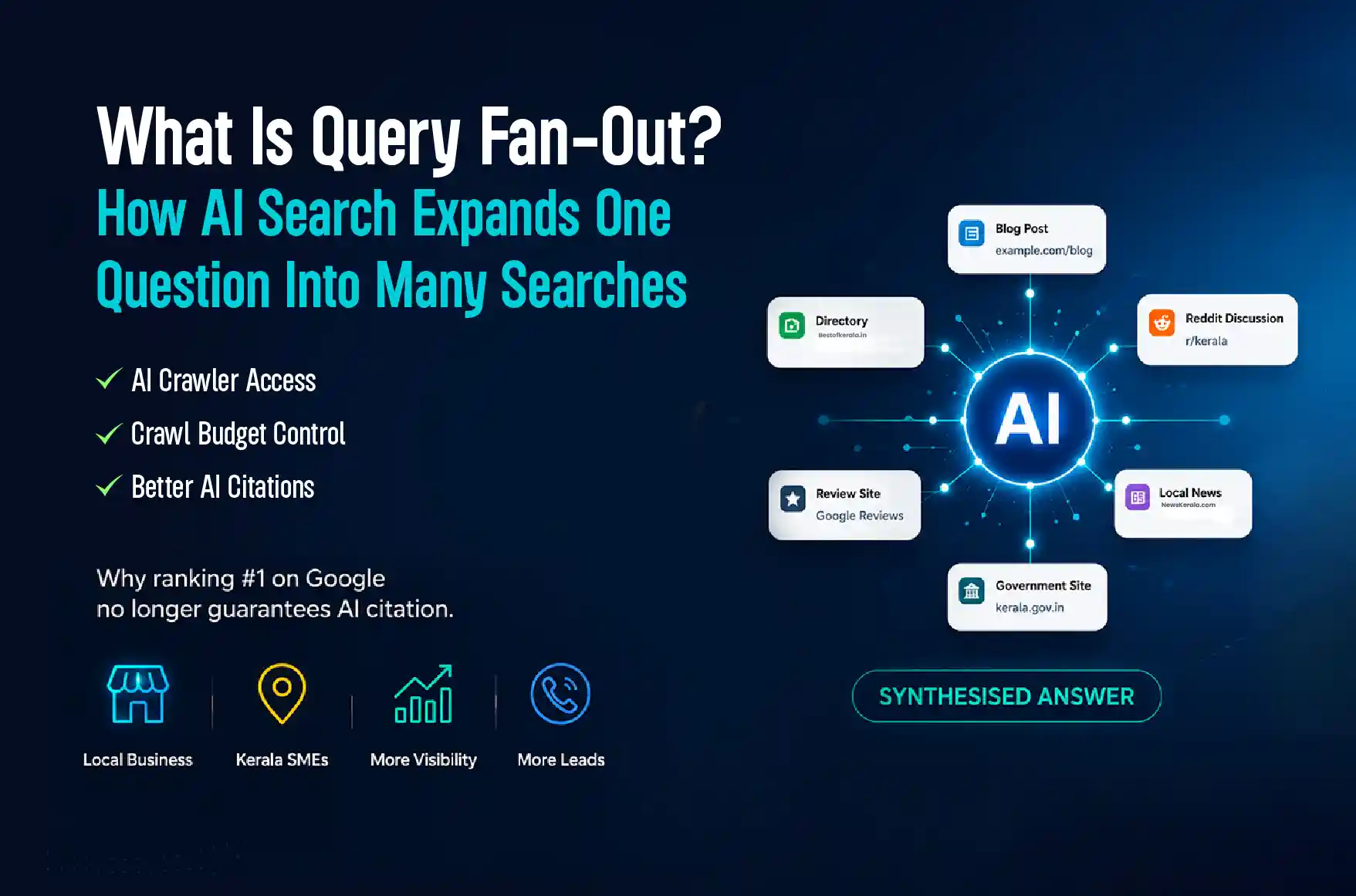
Query fan-out is the background process AI systems use to gather information before generating an answer. When someone asks ChatGPT or Perplexity a question, the AI does not default to Google’s top-ranked page. Instead, it runs multiple related searches — often 10 to 20 — and pulls snippets from various sources to build a single, synthesised answer. Your page could be #1 on Google for a keyword and still never be cited by an AI if it lacks the entity signals, structured data, or topical authority the system expects. This is why traditional search engine optimisation alone is no longer enough for AI-search visibility.
Why Does This Happen?
- AI systems are not ranking engines. They are retrieval-augmented generation (RAG) models that prioritise machine-readable structure over human-friendly ranking signals.
- Entity trust matters more than domain authority. An AI will cite a smaller, trusted source with clear entity markup over a high-DA page that is ambiguous about what it represents.
- Content is fragmented across queries. Your page may answer one specific question well, but the AI runs a fan-out of related queries and finds a better match for each sub-question from different pages.
- Google’s own AI Overviews compete with traffic. Early estimates suggest AI Overviews now appear for roughly 15% of queries, and when they do, click-through rates drop significantly — the Berlin expat guide saw a 70% traffic loss directly attributed to this change.
- Local businesses are especially vulnerable. If your Google Business Profile is incomplete or your website lacks local entity schema, AI systems may bypass you entirely for a larger aggregator or directory.
At-a-Glance Summary
| Factor | Details |
| What is Query Fan-Out? | AI systems run multiple related searches to gather information and generate a single answer. |
| Why It Matters | Your page can rank #1 on Google yet never appear in AI-generated citations. |
| Traffic Impact | The expat guide All About Berlin reportedly lost 70% of its traffic due to Google AI Overviews. |
| Core Cause | AI prioritises machine-readable structure, entities, and retrieval signals over traditional ranking factors. |
| Who Is Affected? | Businesses that rely on organic search visibility, especially local SMEs and service providers. |
| Key Fix | Add entity markup, build topical content clusters, and optimise content for AI retrieval. |
| Timeline | This shift is already happening as AI-powered search experiences continue to expand across major platforms. |
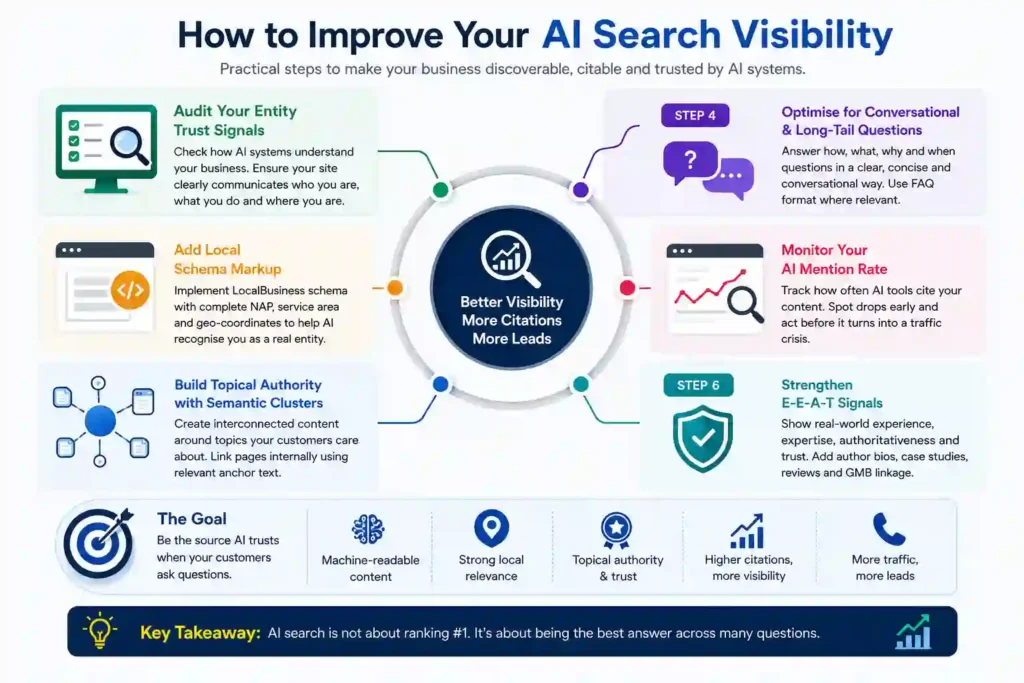
How to Improve Your AI Search Visibility
Step 1 — Audit your entity trust signals
Use Google’s Natural Language API or a free entity extraction tool to check if your homepage clearly represents your business as an entity. The AI needs to understand what you are, where you are, and what you offer. If your site just says “best restaurant in Thrissur” without marking up the address, cuisine type, and opening hours as structured data, the AI may not recognise you as a legitimate source.
Step 2 — Add local schema markup
Implement LocalBusiness schema with complete NAP (name, address, phone), service area, and geo-coordinates. This signals to AI systems that you are a real, located entity — not just a generic content page. For a Kerala business, including the city and district in the schema helps AI localise the answer.
Step 3 — Build topical authority with semantic clusters
Instead of writing one page for “best Ayurveda treatment in Kerala”, create a cluster of pages covering different aspects — types of treatments, practitioner qualifications, cost, testimonials. Link them internally using relevant anchor text. This gives AI systems more reasons to cite you across multiple fan-out queries. This approach is increasingly being adopted by leading businesses working with an experienced SEO company in Kerala to improve both traditional search rankings and AI citation opportunities across platforms like ChatGPT, Gemini, and Perplexity.
Step 4 — Optimise for conversational and long-tail questions
AI Overviews and chatbots prefer answers that match conversational phrasing. Create FAQ-style content that directly answers how, what, why, and when questions. For example, “What is the best time to visit Munnar?” is more likely to be cited than “Munnar travel guide.”
Step 5 — Monitor your AI mention rate
Use manual spot checks (e.g., searching ‘site:chat.openai.com your business name’) or free tools to monitor citations. At Tomatotree digital, we run a monthly AI Visibility Audit for clients to track citation changes. The goal is to spot a drop before it turns into a traffic crisis.
Step 6 — Strengthen E-E-A-T signals
Google’s Search Quality Rater Guidelines emphasize Experience, Expertise, Authoritativeness, and Trustworthiness. These signals help AI systems trust your content as a reliable source for answers. Publish author bios, client case studies, and third-party reviews. Link to your Google Business Profile from every page. The more real-world proof AI systems have, the more likely they are to cite you.
What Happens If You Ignore This?
- Traffic erosion: Your top-ranking pages may lose 50-70% of clicks as AI Overviews occupy the top position — the CTR drop from position 1 to 3 is already approximately 50% in traditional search.
- Loss of local market share: Competitors who adopt entity-rich strategies will capture the AI citations, leaving your business invisible in AI-generated answers.
- Wasted ad spend: If your paid campaigns rely on keywords that AI Overviews now answer directly, those clicks may not convert.
- Brand trust decay: If users never see your brand in AI answers, you lose the top-of-mind positioning that builds long-term trust.
Don’t wait for your traffic to drop. Contact Tomatotree Digital for a free AI Visibility Audit and start future-proofing your online presence.
Common Mistakes to Avoid
| Mistake | Why It’s a Problem | What to Do Instead |
| Optimising only for Google’s top 3 results | AI systems do not rely on Google’s rankings as their primary signal when selecting sources. | Build entity-rich content supported by schema markup and structured data. |
| Ignoring conversational search queries | AI models prefer content that directly answers questions rather than keyword-focused pages. | Create FAQ sections and content that addresses common user questions clearly and concisely. |
| Having a single landing page for a broad topic | Query fan-out favours comprehensive coverage across multiple related subtopics. | Develop topical content clusters with dedicated pages for key subtopics. |
| Not tracking AI citations | Visibility losses may go unnoticed until organic traffic and leads start declining. | Monitor AI mentions and citations regularly using manual checks or AI visibility tools. |
| Using a vague or incomplete Google Business Profile | AI systems are more likely to cite businesses with complete and trustworthy local information. | Fully optimise your Google Business Profile and keep it updated with accurate details and regular posts. |
Expert Tips
- Add FAQ schema to your most visited service pages. This helps AI extract concise answers directly.
- Use a semantic keyword tool like Ahrefs or Semrush to identify related long-tail questions your audience searches for — then create content that answers each one in a separate page.
- Run a Core Web Vitals test monthly. LCP above 2.5 seconds reduces the chance that Google passes your page to AI systems.
- Set up a simple spreadsheet to log which of your pages are being cited by ChatGPT. If you notice a drop, update the content with fresh stats and recent examples.
- Build at least 3–5 high-quality backlinks from local Kerala websites (tourism boards, local directories) to strengthen entity trust within AI training data.
Frequently Asked Questions
What is query fan-out and why should a Kerala business care?
Query fan-out is when an AI system runs multiple searches to build one answer. Your business could be #1 on Google but never cited by an AI because it lacks machine-readable structure. For Kerala SMEs, that means losing leads to AI-sourced competitors.
How does AI Overview traffic loss happen?
When Google’s AI Overview answers a query directly on the search results page, users don’t click through to websites. The Berlin expat guide All About Berlin lost 70% of its traffic this way. The same can happen to any business that relies on organic clicks.
What is the first step to improve AI search visibility?
Audit your entity trust signals. Use Google’s Natural Language API to check if your homepage clearly represents your business as a distinct entity with location, services, and contact information.
Do I need to change my entire SEO strategy?
No, but you need to add an ‘AI layer’ to your existing SEO. Focus on structured data, topical clusters, and conversational content that answers direct questions. Traditional ranking factors still matter, but they are no longer sufficient.
How quickly can I see results from these changes?
It depends on how much entity trust your domain already has. Typically, businesses see new AI citations within 2–4 months after implementing schema markup and creating topical clusters.
Key Takeaways
- Query fan-out means AI systems may ignore your #1 ranking page if it lacks machine-readable signals
- Google AI Overviews now appear for ~15% of queries and can reduce traffic by 70%
- Add LocalBusiness schema and build topical clusters to increase AI citation chances
- Monitor your AI mention rate monthly — do not wait for a traffic drop to react
- The shift from page-one ranking to AI citation is already underway; act now or lose local leads