
Prajesh Satheesh
Senior SEO/GEO Specialist
- Human Verified content
5 min read
AI search is reshuffling the deck. Social SEO is no longer optional. If you run a local business in Kerala — a restaurant in Kochi, a dental clinic in Thiruvananthapuram, a real estate firm in Kozhikode — you’ve probably noticed your organic leads aren’t what they used to be. AI Overviews now appear for up to 15% of Google queries [1], and a meaningful share of clicks that once went to your website now stop inside a generated answer. At the same time, platforms like Instagram and YouTube are becoming full-fledged search engines. This article gives you five actionable shifts to make before Q3 to protect and grow your search visibility.
What You Will Learn
- Why AI Overviews are shrinking traditional click-through rates
- How social platforms are becoming search engines your customers actually use
- A simple audit framework to check your AI-search readiness
- Practical content and technical fixes that work for small teams
- Why ignoring social SEO now will cost you leads within 12 months
What Is AI Search and Social SEO?
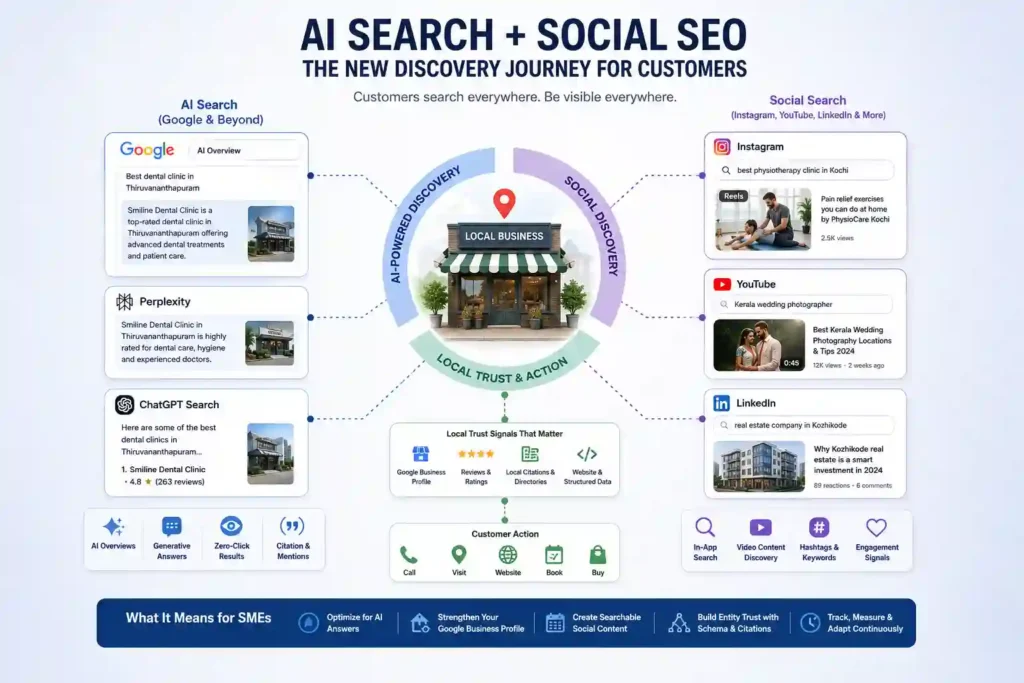
AI search refers to generative search results — AI Overviews in Google, Perplexity, ChatGPT Search — that answer a user’s question without requiring a click. Social SEO means optimising your presence on platforms like Instagram, YouTube, and LinkedIn so your business appears when users search within those apps. Together, they’re rewriting how Kerala consumers discover local services. A patient searching “best root canal clinic in Kozhikode” might get a Google AI Overview that cites your Google Business Profile instead of your website. Or a bride searching “Kerala wedding photographer” finds a YouTube reel that ranks your video first.
Why Do These Shifts Happen?
- Google’s goal is to keep users on its platform longer; AI answers reduce the need to visit other websites.
- Social platforms now process billions of searches per day — Instagram alone reported over 2 billion monthly active users, many using search natively [2].
- User behaviour shifted: younger demographics (18–34) often start searches on TikTok or Instagram, not Google [2].
- Google’s algorithm now prioritises E-E-A-T signals, making structured data and entity trust more important than keywords alone.
- The rise of conversational search means queries are longer and more specific, favouring content that directly answers questions.
At-a-Glance Summary
| Factor | Details |
| AI Overviews prevalence | up to 15% of all Google queries show an AI-generated answer [1] |
| Traditional CTR change | Top 3 organic results get ~54% of clicks [1], but AI answers reduce click-through further |
| Social search growth | Social platforms are used by 40%+ of users for product/service research [2] |
| Core Web Vitals requirement | LCP of 2.5 seconds or less for a Good rating |
| Entity trust impact | Google uses entity recognition to verify business credibility; schema markup helps |
| Budget priority for 2026 | Invest in structured data, local content, and social profiles equally |
How to Respond to AI Search and Social SEO Shifts
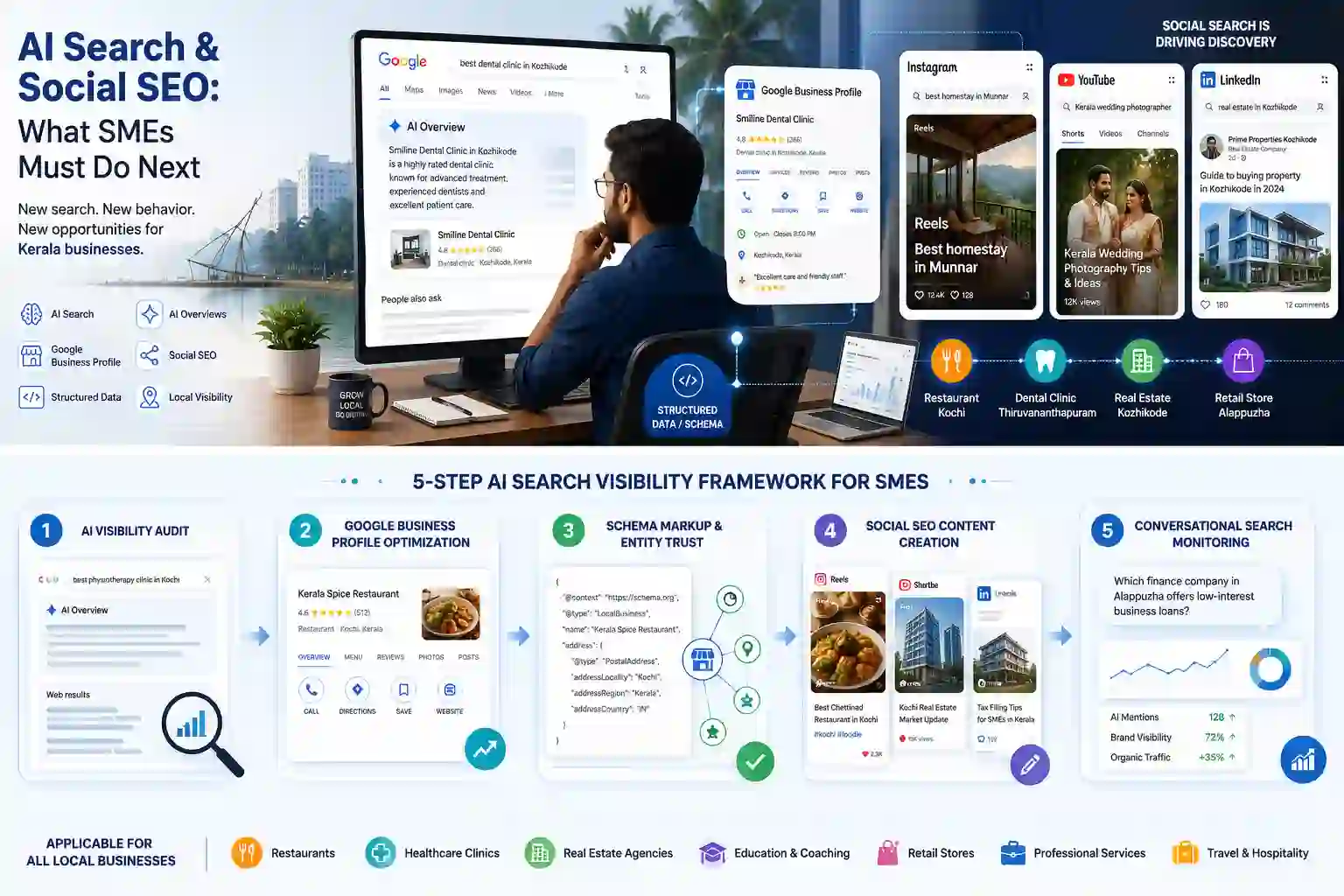
Step 1 — Audit Your AI Search Visibility
Run a handful of core queries through an incognito browser and note whether an AI Overview appears. Check if your business is cited within it. If not, the gap is in topical authority and structured data. A practical approach is to use an AI Visibility Audit: identify 10 high-value queries, check for AI presence, and map missing schema or content.
Step 2 — Optimise Your Google Business Profile for AI Retrieval
AI Overviews frequently pull from Google Business Profiles for local intent queries. Ensure your GBP categories are precise, your description includes entity-rich language (e.g., “ISO-accredited pathology lab in Thrissur”), and your reviews contain keywords customers actually use. Add posts with embedded keywords at least weekly.
Step 3 — Build a Structured Data Layer for Entity Trust
Schema markup helps Google recognise your business as a credible entity. Implement LocalBusiness schema with opening hours, service area, and accepted payment methods. Add FAQ schema to your most visited pages. This increases the chance your data gets cited in AI answers.
Step 4 — Create Social Content Designed for Search
Treat Instagram Reels, YouTube Shorts, and LinkedIn posts as searchable assets. Use alt text, captions, and hashtags that reflect real user queries. For example, a homestay in Munnar should post a video titled “Best homestay in Munnar for couples – price, location, tips” rather than just scenic shots.
Step 5 — Monitor and Adjust for Conversational Search
Users now ask full questions like “Which finance company in Alappuzha offers low-interest loans?” Review your content: does it answer that specific question in a clear, structured way? Use subheadings and bullet points within blog posts to surface answers for AI.
What Happens If You Ignore This?
- Your organic traffic may decline further as AI answers capture more of the click share.
- Competitors who optimise for social SEO will capture leads you lose on Google.
- Your Google Business Profile might stop appearing in AI Overviews, reducing local discoverability.
- Marketing spend on traditional SEO alone will yield diminishing returns without social and entity strategies.
- Your brand could become invisible to the 18–34 demographic that uses social platforms as primary search tools.
Common Mistakes to Avoid
| Mistake | Why It’s a Problem | What to Do Instead |
| Ignoring social search entirely | Customers already search for services on Instagram/YouTube; for example, a Kochi bakery that doesn’t optimize Instagram for ‘best plum cake near me’ loses out to competitors who do. | Create a social SEO content calendar and post search-optimized Reels and Shorts weekly. |
| Reusing old blog content without structured data | AI Overviews pull from FAQ snippets and schema-rich pages; plain text doesn’t rank as well | Add FAQ and HowTo schema to all evergreen posts |
| Focusing only on Google rankings | AI Overviews and social platforms use different signals; rank on Google but not in AI answers | Distribute content across owned and social platforms |
| Writing for keywords instead of entities | Google now understands concepts, not just strings; “top-rated” matters as much as “cardiology” | Use entity-rich language: titles, qualifications, authority references |
| Not tracking brand mentions in AI citations | You can’t improve what you don’t measure | Set up alerts for brand name + “AI Overview” or “Perplexity” |
Expert Tips
- Use Google’s Rich Results Test to validate your schema markup — a single error can block AI retrieval.
- For local service businesses, create a dedicated “How It Works” page with step-by-step content perfectly aligned to featured snippet targets.
- Repurpose top-performing Google posts into Instagram carousels. The entity signals from Google can transfer and improve social search ranking.
- Add a “People also ask” section to your FAQ page — this naturally mirrors conversational queries and increases AI citation chances.
- Track your Machine Readability Score by checking if key entity data (NLP, address, hours) is parseable across your site and Google Business Profile.
Key Takeaways
- AI Overviews and social search are shifting where leads come from; ignoring either will reduce your visibility within 12 months.
- Structured data and entity trust are now core ranking signals for both Google and AI-powered search.
- Your Google Business Profile is a primary data source for AI Overviews — keep it complete, accurate, and keyword-rich.
- Social platforms are search engines; treat your posts as indexable content with keywords and descriptions.
- Start with a simple AI Visibility Audit: pick 10 queries, check for AI presence, fill the gaps.
Get Your Free AI Visibility Audit
AI search and social SEO are changing fast. Is your business ready? Tomatotree Digital helps Kerala SMEs audit their AI search visibility and implement structured data, social SEO, and entity optimization. Book a free 30-minute consultation to get a custom AI Visibility Audit for your business. No pressure, just actionable insights to protect and grow your leads.
References
Frequently Asked Questions
How do AI Overviews affect my click-through rates?
Early data suggests that when an AI Overview appears, traditional click-through rates to the top organic result can drop. However, being cited in the Overview can still drive qualified traffic from users who want more detail.
Is social SEO really necessary for a local business in Kerala?
Yes. A growing share of discovery happens on social platforms, especially among younger customers. If your target audience includes anyone under 35, social SEO is now as important as traditional search engine optimization.
What is the most important technical fix for AI search visibility?
Adding structured data (schema markup) to your website. Schema helps Google and AI systems understand your content as factual entities rather than just text, which increases the likelihood of being cited in AI answers.
How can I check if my business is cited in AI Overviews?
Perform a manual search in an incognito window for your key services. If an AI Overview appears, scroll to see if your business name or URL is referenced. You can also use tools like Brand24 or Google Alerts to monitor mentions.
Do I need a separate budget for social SEO?
Not necessarily. You can repurpose existing content — blog posts become LinkedIn articles, customer testimonials become Instagram Reels — which makes social SEO a matter of format adaptation rather than fresh budget.