How Can Answer Engine Optimization Improve AI Visibility for SMEs?
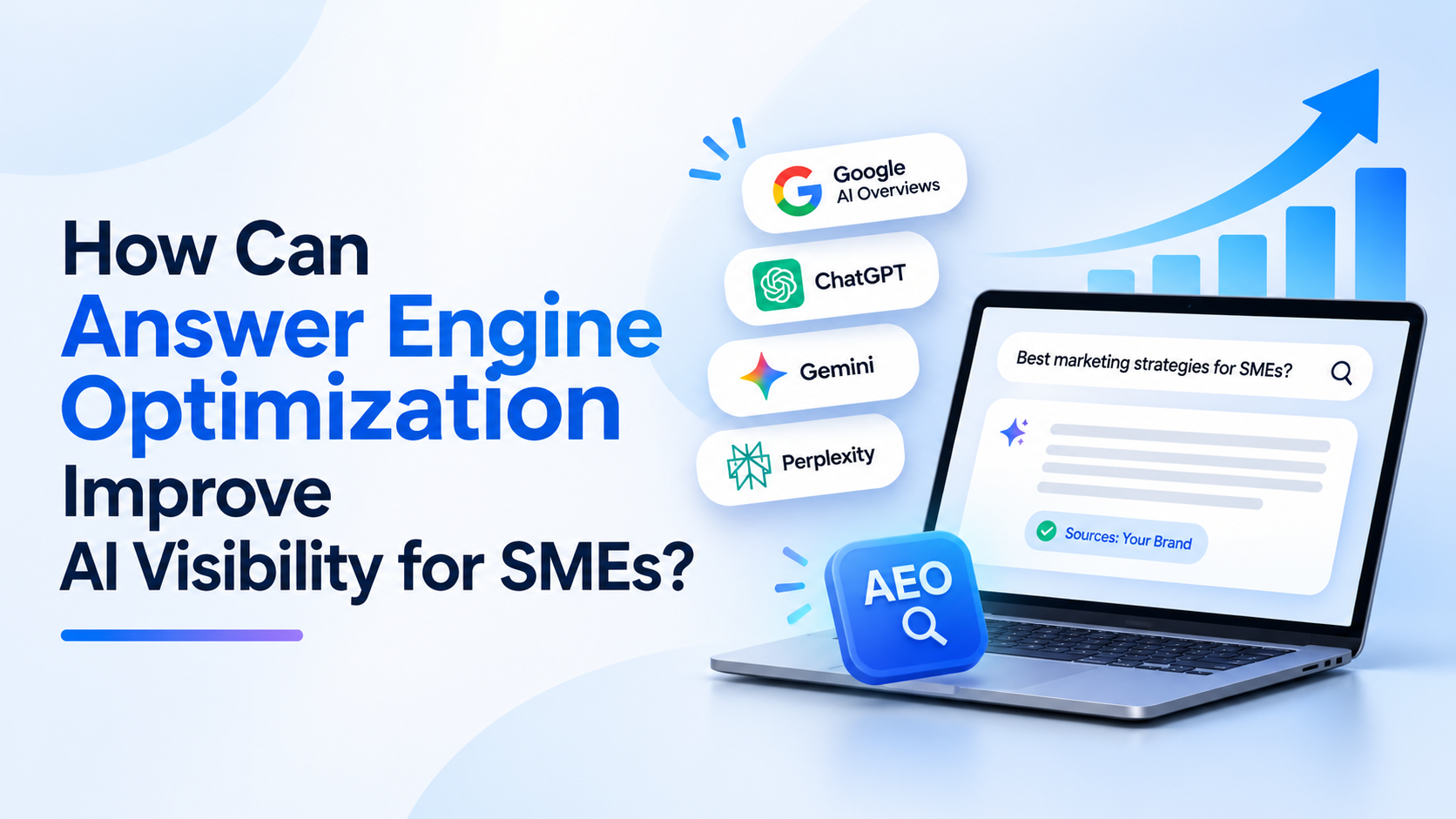
Answer engine optimization is the practice of structuring content, brand entities, and technical foundations so AI systems such as Google AI Overviews, ChatGPT, Gemini, and Perplexity can retrieve and cite you. It matters now because Google’s AI Overviews appear on roughly 15% of queries, and a growing share of searches reportedly end without a click.
What You Will Learn
- Why AI answers shrink the click and which queries still convert
- What a 30-minute AI Visibility Audit actually checks
- How to make a page quotable by answer engines
- Which entity and schema signals carry weight
- What to stop doing before you fix retrieval
What Is Answer Engine Optimization?
Answer engine optimization (AEO) is the discipline of making a business’s content and brand entity retrievable and citable by AI answer systems — Google AI Overviews, ChatGPT, Gemini, Perplexity, and Copilot. Traditional SEO competes for a position in a list of links. AEO competes for a sentence inside a synthesised answer that names you as the source. It affects any business that depends on inbound enquiries: clinics, consultancies, e-commerce brands, professional firms. The overlap with GEO (Generative Engine Optimisation) is real, but AEO leans harder on question-shaped content, clean extraction, and entity consistency than on broad generative visibility. If your pages cannot be quoted cleanly, you are not in the answer.
Why Does the AI Visibility Gap Happen?
Most SMEs did not lose visibility because their content got worse. They lost it because retrieval changed.
- Answers are buried. Service pages open with brand story instead of a direct answer, and extraction models skip the preamble.
- The brand is not a recognised entity. Two trading names, no Organization schema, an unclaimed Google Business Profile — recognition fragments.
- Content depends on JavaScript. If the core text only appears after client-side rendering, some retrieval systems see an empty page.
- No topical depth. A dozen unrelated posts signal nothing about authority on any single subject.
- Crawlers blocked by accident. Staging rules, aggressive firewalls, or robots.txt directives can quietly lock out AI crawlers.
- Slow pages. Google treats 2.5 seconds as the “Good” LCP threshold; above it, crawl efficiency and engagement both suffer.
At-a-Glance Summary
| Factor | Details |
|---|---|
| Primary metric | Whether AI systems cite your page or a competitor’s |
| Where answers come from | AI Overviews, ChatGPT, Gemini, Perplexity, Google AI Mode |
| Typical first signal | Two to six weeks after structural fixes, by observation |
| Biggest single lever | A written, extractable answer near the top of each money page |
| Common blocker | Brand name inconsistency across site, profile and directories |
| Technical threshold | LCP at or under 2.5 seconds |
| Who owns the work | Marketing lead plus whoever controls the website build |
| Review cadence | Monthly citation check, not an annual audit |
How to Build AI Search Visibility in Six Steps
Step 1 — Run a 30-Minute AI Visibility Audit
Take your five highest-intent commercial queries and run each one through Google with AI Overviews, then ChatGPT, then Perplexity. Record whether you appear, who gets cited instead, and which passage the model quotes. That spreadsheet is your baseline — more actionable than another keyword report.
Step 2 — Rewrite One Page to Answer First
Choose the page closest to revenue. Add a 40–60 word direct answer directly under the H1, before any positioning language. Then support it with clearly named subsections. Models extract passages, not pages. Remember what happens after the AI answer: the reader still wants proof and a way to verify you locally, so the body must supply both.
Step 3 — Fix Entity Signals Before You Fix Content
Your business name, address, service description, and categories should match exactly across your website, Google Business Profile, and major directories. Add Organization schema with sameAs links to verified profiles. In client work at Tomatotree digital, mismatched trading names are the most frequent reason a brand fails to be recognised as a single entity. For profile-level detail, this guide to Google Business Profile AI messaging covers the practical setup.
Step 4 — Make the Page Machine Readable
Serve the main content in HTML rather than injecting it with JavaScript, keep LCP at or under 2.5 seconds, and add FAQPage or Service schema only where it accurately describes visible content. Audit for orphan pages and near-duplicate service pages; they consume crawl budget that belongs to the pages you want cited.
Step 5 — Build Semantic Clusters, Not Isolated Posts
Group content around one commercial topic with a hub page and eight to twelve supporting pages that interlink. Authority on a topic is earned through depth and internal linking, not posting frequency. Our breakdown of why SEO alone won’t deliver AI search visibility shows where that structure usually breaks.
Step 6 — Review Citations Monthly
Re-run the Step 1 audit on the first working day of each month. Track which pages get cited and which queries return nothing. Answer sets shift in weeks, not years, once structure changes.
What Happens If You Ignore This?
Ignoring retrieval is not a neutral choice. It is a slow transfer of visibility to whoever structures better.
- Competitors get named in answers you used to rank for, and the click never reaches you.
- Lead quality drifts: fewer enquiries, more tyre-kickers, harder forecasting.
- Budget keeps flowing into content no retrieval system can extract.
- Your profile and reviews do less work than they should for local business discoverability.
- Rebuilding later costs more, because entity trust and topical authority take time to accumulate.

Common Mistakes to Avoid
| Mistake | Why It’s a Problem | What to Do Instead |
|---|---|---|
| Stuffing the keyword “AEO” into every paragraph | Reads as spam to humans and adds nothing extractable | Write one direct answer, then support it |
| Publishing daily short posts | Dilutes topical authority and wastes crawl budget | Publish fewer, deeper pages that interlink |
| Adding schema that does not match visible content | Mismatched markup erodes trust in your structured data | Mark up only what a reader can see |
| Chasing AI Overviews for broad research queries | High volume, low intent, rarely produces an enquiry | Target commercial queries with local intent |
| Leaving the Google Business Profile half-filled | Local AI answers lean on profile data | Keep hours, services and categories current |
| Treating AI visibility as a one-off project | Answer sets change weekly | Re-audit on a fixed monthly date |
Expert Tips
One thing most teams miss: after reading an AI Overview, the user still needs proof, a price range, and a way to verify you locally. Every page that earns a citation should answer that second question too.
- Test machine readability by disabling JavaScript and reloading your top page. If the answer text disappears, retrieval probably suffers too.
- Use Google Search Console’s Performance report to find queries where you sit in positions 4–10; those pages are prime extraction candidates.
- Check LCP in PageSpeed Insights. 2.5 seconds is Google’s stated “Good” threshold, not a target to negotiate.
- Chase third-party corroboration. Industry associations, local press and directories often decide whether a model trusts a brand.
- Keep one canonical business name everywhere, including old invoices and directory listings.
Over the next 12–24 months, I expect AI citation share to appear as a standard reporting line beside organic traffic. Teams may need to prepare a manual baseline now so they have something to compare against later.

Key Takeaways
- AI answer systems reward extractable structure, not publishing volume.
- Entity consistency across site, Google Business Profile and directories decides whether you get recognised at all.
- HTML-rendered content and an LCP at or under 2.5 seconds keep you retrievable.
- A monthly manual citation audit beats waiting for a standard metric.
- Fix the pages closest to revenue first; the rest can wait a quarter.
References
- Answer Engine Optimization: How to Improve AI Visibility — Neil Patel
- Google Search Central Documentation
- Google Search Quality Rater Guidelines
- Schema.org Structured Data Vocabulary
- Published by Tomatotree digital
Frequently Asked Questions
What is answer engine optimization in simple terms?
It is the work of making your website and brand easy for AI tools to quote. Instead of chasing a ranking position, you structure pages so Google AI Overviews, ChatGPT or Perplexity can pull a clear answer from them and name your business as the source.
How long does it take to see AI search visibility improvements?
Practitioners typically see structural changes reflected in AI answers within two to six weeks. Entity-level changes take longer because they depend on third-party corroboration. Re-run the same query set monthly so you can separate genuine movement from normal fluctuation in answer sets.
Should I block or allow AI crawlers?
It depends on your business model. Publishers selling content may reasonably restrict AI crawlers, while service businesses that want to be cited generally should allow them. Check your robots.txt and firewall rules with a developer, then confirm pages render for non-browser requests.
Does AEO replace SEO?
No. AEO sits on top of solid technical SEO. If a page is slow, duplicated or undiscoverable, answer formatting will not rescue it. Top three organic results still receive roughly 54% of clicks, so treat AEO as an addition to your SEO strategy, not a replacement.
How do I measure AI search visibility?
Build a fixed set of 10 to 20 commercial queries and check them monthly across Google AI Overviews, ChatGPT and Perplexity. Record presence, the source cited, and the passage quoted. There is no settled industry metric yet, so a consistent manual baseline is more honest than any dashboard claim.